Time value of
money (TVM) is the idea that money that is available at the present time
is worth more than the same amount in the future, due to its potential earning
capacity. This core principle of finance holds that provided money can earn
interest, any amount of money is worth more the sooner it is received. One of
the most fundamental concepts in finance is that money has a time value
attached to it. In simpler terms, it would be safe to say that a rupee was
worth more yesterday than today and
a rupee today is worth more than a dollar tomorrow.
There are five (5) variables that
you need to know:
1.
Present value (PV) - This is your current
starting amount. It is the money you have in your hand at the present
time, your initial investment for your future.
2.
Future value (FV) - This is your ending
amount at a point in time in the future. It should be worth more than the
present value, provided it is earning interest and growing over time.
3.
The number of periods (N) - This is
the timeline for your investment (or debts). It is usually measured in years,
but it could be any scale of time such as quarterly, monthly, or even daily.
4.
Interest rate (I) - This is the growth rate
of your money over the lifetime of the investment. It is stated in a percentage
value, such as 8% or .08.
5.
Payment amount (PMT) - These are a series of
equal, evenly-spaced cash flows.
The time value of money is also related to the concepts of inflation and purchasing power. Both factors need to be taken into consideration along with whatever rate of return may be realized by investing the money.
Why is this important?
Because
inflation constantly erodes the value, and therefore the purchasing power, of money.
It is best exemplified by the prices of commodities such as gas or food. If, for example, you were given a
certificate for Rs 100 of free gasoline in 1990, you could have bought a lot
more gallons of gas than you could have if you were given Rs 100 of free gas a
decade later.
Inflation and purchasing power must be factored in when you invest money because to
calculate your real return on an investment, you must subtract the rate of
inflation from whatever percentage return you earn on your money. If the rate
of inflation is actually higher than the
rate of your investment return, then even though your investment shows a nominal positive return, you are
actually losing money in terms of purchasing power. For example, if you earn a
10% on investments, but the rate of inflation is 15%, you’re actually losing 5%
in purchasing power each year (10% – 15% = -5%).
Time Value of Money Formula
The time value
of money is an important concept not just for individuals, but also for
making business decisions. Companies consider the time value of money in making
decisions about investing in new product development, acquiring new business
equipment or facilities, and establishing credit
terms for the sale of their products or services. A specific
formula can be used for calculating the future value of money
so that it can be compared to the present value:
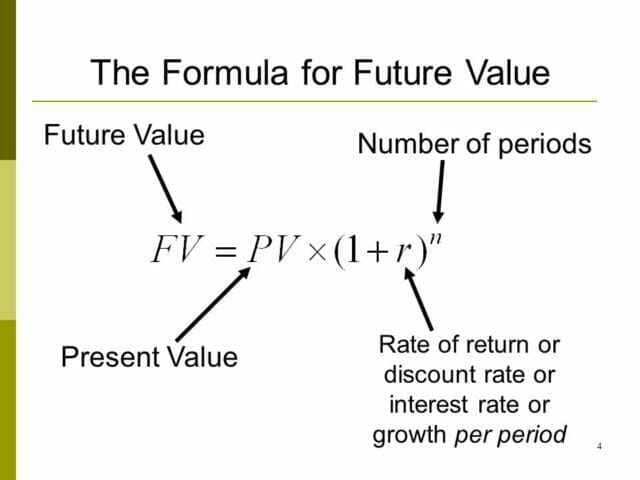
Where:-
FV =
the future value of money
PV = the present value
i = the interest rate or other return that can be earned on the money
t = the number of years to take into consideration
n = the number of compounding periods of interest per year
PV = the present value
i = the interest rate or other return that can be earned on the money
t = the number of years to take into consideration
n = the number of compounding periods of interest per year
Using
the formula above, let’s look at an example where you have rs5,000 and can
expect to earn 5% interest on that sum each year for the next two years.
Assuming the interest is only compounded annually, the future value of your rs 5,000
today can be calculated as follows:
FV
= rs 5,000 x (1 + (5% / 1) ^ (1 x 2) = rs 5,512.50
Present
Value of Future Money Formula
The
formula can also be used to calculate the present
value of money to be received in the future. You simply
divide the future value rather than multiplying the present value. This can be
helpful in considering two varying present and future amounts. In our original
example, we considered the options of someone paying your rs 1,000 today versus
rs 1,100 a year from now. If you could earn 5% on investing the money now, and
wanted to know what present value would equal the future value of rs 1,100 – or
how much money you would need in hand now in order to have rs 1,100 a year from
now – the formula would be as follows:
PV = rs 1,100 / (1 + (5% / 1) ^ (1 x 1) = rs 1,047
The
calculation above shows you that, with an available return of 5% annually, you
would need to receive rs 1,047 in the present to equal the future value of rs 1,100
to be received a year from now. To make things easy for you, there are a number
of online calculators to figure the future value or present value of money.
Calculation of Net Present value
Net present value (NPV) is a method used to determine the current value of all
future cash flows generated
by a project, including the initial capital investment. It is
widely used in capital budgeting to
establish which projects are likely to turn the greatest profit.
The formula for NPV
varies depending on the number and
consistency of future cash flows. If there’s one cash flow from a project
that will be paid one year from now, the calculation for the net present value
is as follows:
Formula for NPV
NPV = (Cash
flows)/( 1+r)i
i- Initial
Investment
Cash flows= Cash flows in the time period
r = Discount rate
i = time period
As seen in the formula – To derive the
present value of the cash flows we need to discount them at a particular rate.
This rate is derived considering the return of investment with similar
risk or cost of borrowing, for the investment.
NPV takes into consideration the time value
of money. The time value of money simply means that a rupee today is of more
value today than it will be tomorrow.
Consider it this way: You have Rs. 100
today and you can buy ten chocolates. The same Rs. 100 will be able to
get you not more than the same 5 chocolates may be after one year. So the
cash flows earned today are of more value than as on a later date.
After discounting the cash flows over
different periods, the initial investment is deducted from it. If the
result is a positive NPV then the project is accepted. If the NPV is negative
the project is rejected. And if NPV is zero then the organization will
stay indifferent.
Let us say Nice Ltd wants to expand its
business and so it is willing to invest Rs 10,00,000.
The investment is said to bring an inflow of
Rs. 100,000 in first year, 250,000 in the second year, 350,000 in third
year, 265,000 in fourth year and 415,000 in fifth year. Assuming the discount
rate to be 9%. Let us calculate NPV using the formula.
Year
|
Flow
|
Present value
|
Computation
|
0
|
-1000000
|
-1000000
|
|
1
|
100000
|
91743
|
100000/(1.09)
|
2
|
250000
|
210419
|
250000/(1.09)^2
|
3
|
350000
|
270264
|
350000/(1.09)^3
|
4
|
265000
|
187732
|
265000/(1.09)^4
|
5
|
415000
|
269721
|
415000/(1.09)^5
|

No comments:
Post a Comment